
A Guide to Professional Strobe Light Installation in Fort Myers
When your crew is working on or near a busy road, professional strobe light installation isn't just an option—it's one of the most important safety measures you can take. It carves out a clear zone of awareness that protects your team, your valuable equipment, and the public from accidents that are as costly as they are dangerous. For any work vehicle, this is a must-have investment in visibility and job site safety.
Why High-Visibility Strobe Lighting Is Essential for Work Vehicles
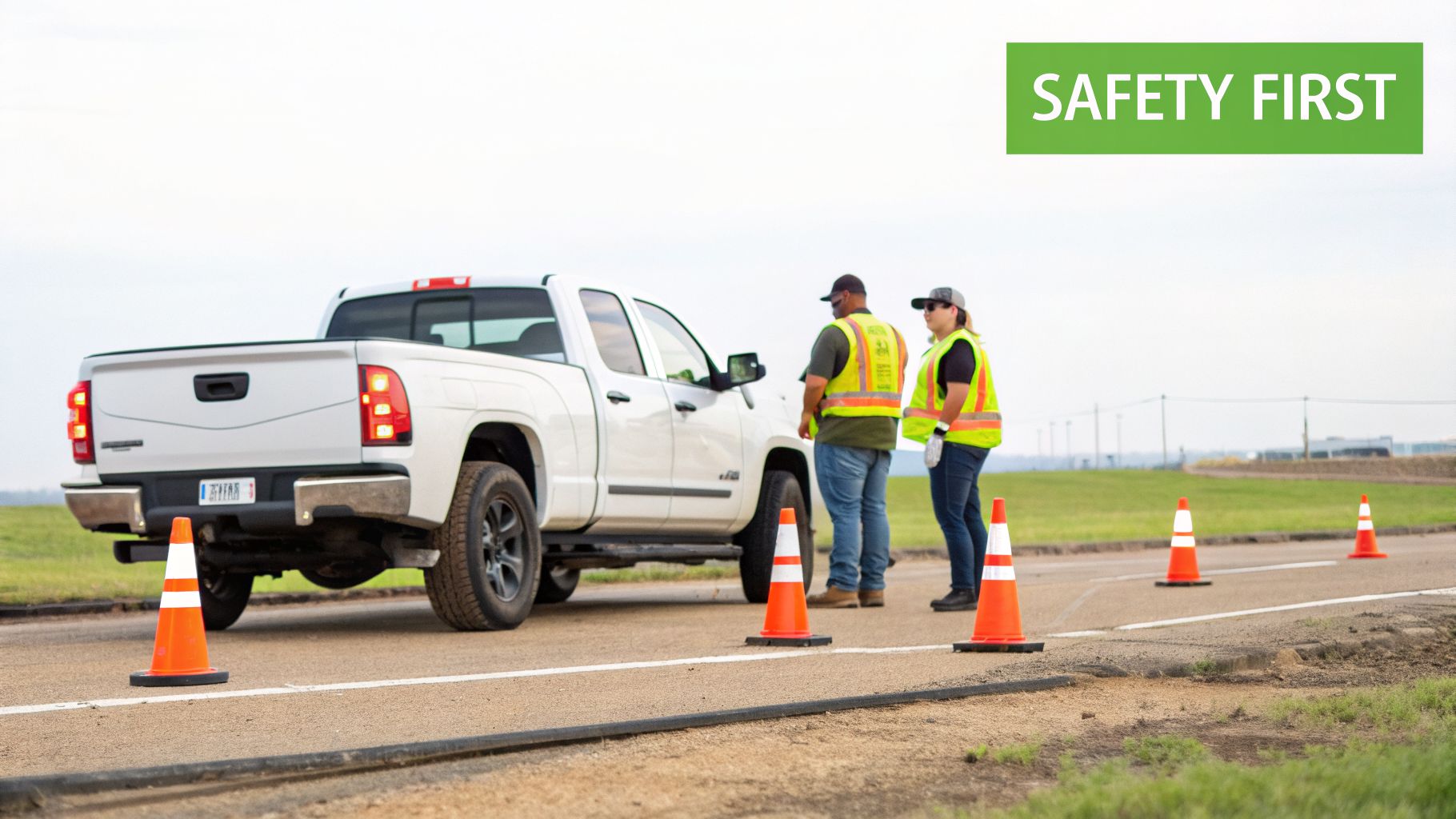
Think of your work truck parked on the shoulder. To a driver zipping by, it's just another part of the scenery until it's too late. This is a daily reality in places like Fort Myers and across Lee County, where construction, landscaping, and utility crews are often working just inches from live traffic. High-quality strobe lights are your truck’s best defense, acting like a lighthouse that cuts through the noise and forces other drivers to pay attention.
A professional installation goes beyond just bolting on some lights. It's about engineering a bulletproof electrical system designed to work every time, without fail, even in the face of Florida’s brutal heat, humidity, and daily operational abuse.
Protecting Your Crew and Your Gear
Your most important assets aren't the tools in the truck bed; they're the people on your team. Effective strobe lighting creates a visible buffer that dramatically lowers the risk of a roadside disaster. This enhanced visibility is non-negotiable for a few key reasons:
- Crew Safety: It grabs the attention of distracted drivers, alerting them to your team members working around the vehicle.
- Asset Protection: It helps prevent collisions that can destroy expensive equipment, sideline a truck, and bring your operations to a halt.
- Public Safety: It guides other motorists safely around your work zone, minimizing traffic chaos and the potential for secondary accidents.
Good lighting isn't a luxury. It's a core component of a safe work environment, and the cost of a professional setup is nothing compared to the cost of a single serious accident.
Staying Compliant and Avoiding Costly Fines
Florida has very specific laws about auxiliary vehicle lighting. Using the wrong color or an unapproved flash pattern can lead to hefty fines and legal headaches. Remember, red and blue lights are strictly reserved for authorized emergency vehicles, and misuse carries serious penalties.
A professional installation ensures your setup is fully compliant. We use the correct amber and white lights with legal flash patterns, so your fleet is always road-legal and your business is protected from liability.
More companies are realizing just how crucial this is. The global strobe lighting market is expected to hit an estimated $3.4 billion by 2034, largely because businesses are ditching old xenon systems for far more reliable and efficient LED technology. Recent industry data shows that fleet managers are quickly catching on to the superior performance and long-term value of modern LEDs. You can dig into the data and see more on this trend by checking out the strobe lighting market growth at gminsights.com.
Investing in a professional strobe light installation is a direct investment in safety, compliance, and your own peace of mind. Take a look at our full range of professional-grade emergency lighting solutions to find the perfect setup for your vehicles.
How To Select The Right Strobe Lights For Your Fleet
Picking the right strobe lights for your work trucks can feel overwhelming. With so many specs and options, it’s easy to get lost. But the mission is actually very simple: make your vehicles impossible to miss and keep your crew safe, no matter the conditions.
Let's cut through the jargon and focus on what really matters. A solid strobe light installation is all about choosing the right hardware from the start, and that begins with one fundamental choice.
LED vs. Xenon: The Technology Showdown
Your first big decision is between modern LED strobes and the older, traditional xenon gas-discharge lights. While they both flash, the way they perform—and what they cost you in the long run—are worlds apart.
Think about the lightbulbs in your house. Remember the old incandescent bulbs that got incredibly hot, burned out all the time, and ran up your power bill? That’s your xenon strobe. Now think of the new LED bulbs that stay cool, last for years, and barely make a dent in your energy costs. That’s your LED strobe. The principle is exactly the same.
Xenon strobes create a flash by shooting a blast of high-voltage electricity through a tube of xenon gas. It produces a very bright, very quick flash, but it’s an old-school process that wastes a ton of energy as heat. This puts a heavy strain on the bulb itself and your truck’s electrical system.
LEDs (Light Emitting Diodes), on the other hand, are solid-state electronics. They generate brilliant light by passing a tiny amount of current through a semiconductor. The process is incredibly efficient, creating almost no heat and using a fraction of the power. For any work truck, especially one running in Florida's heat, the difference is night and day.
To really put it into perspective, let's look at a head-to-head comparison.
LED vs. Xenon Strobe Lights: A Head-to-Head Comparison
When you break down the key differences, it becomes clear why modern fleets have overwhelmingly moved to LED technology. While xenon strobes were the standard for decades, LEDs offer superior performance, durability, and long-term value in every meaningful category.
| Feature | LED Strobes | Xenon Strobes |
|---|---|---|
| Energy Use | Extremely low power draw, minimizing battery strain. | High power consumption, requiring robust power supplies. |
| Lifespan | Up to 50,000+ hours of continuous operation. | Typically 2,000 to 4,000 hours before replacement. |
| Durability | Solid-state design is highly resistant to vibration and shock. | Fragile glass tubes and filaments are prone to failure. |
| Brightness | Maintains consistent, powerful brightness over its entire life. | Light output can dim over time as the gas tube degrades. |
| Activation Time | Instant on/off capability for complex flash patterns. | Requires a "warm-up" and "cool-down" cycle between flashes. |
For a fleet manager, the math is straightforward. The incredible lifespan and rock-solid durability of LEDs mean far fewer replacements, less vehicle downtime, and a significantly lower total cost of ownership. It's an investment that pays for itself.
Matching Light Types To Your Vehicle And Job
Once you’ve decided on LED technology—the smart choice—the next step is figuring out which types of lights you need and where to put them. A single light almost never gets the job done. The real goal is to create a full 360-degree zone of visibility around your vehicle.
Different light styles are built for different jobs. By mixing and matching them, you can build a custom warning system perfectly suited to your truck and the work you do.
Common Types of Strobe Lights:
- Rooftop Light Bars: These are the workhorses of visibility. Mounted high on the cab, they command attention from long distances and all directions, making them essential for any vehicle working in or near traffic.
- Grille and Surface Mounts: Small, tough, and surprisingly bright. These "puck" style lights are perfect for adding forward-facing and side warnings. You can mount them right in the grille, on bumpers, or anywhere along the side of the truck.
- Visor and Dash Lights: These are interior lights that offer a powerful forward-facing punch without drilling any holes in your vehicle's exterior. They're a great choice for temporary setups or on leased vehicles.
- Hideaway Strobes: Want a clean, factory look? These ultra-compact lights fit directly inside your existing headlight and taillight assemblies. They’re invisible when off but deliver a powerful, synchronized flash when you hit the switch.
For example, a construction foreman’s F-250 that works along the highway needs a full-size rooftop bar for maximum impact. You'd combine that with amber and white strobes in the grille and on the rear bumper for when the truck is parked at a job site entrance.
On the other hand, a plumber's van that spends its days in tight urban neighborhoods might be better off with several surface-mount strobes on all four corners and a smaller mini-light bar on the roof. This setup ensures it’s seen from every angle without the size of a full bar getting in the way.
The right combination is all about your daily operations. Ready to see the options? You can explore a wide variety of professional-grade strobe lights at truckstuff.com to find the exact models your fleet needs to stay safe and visible.
Getting Seen From Every Angle: Smart Strobe Placement for 360° Safety
The brightest, most expensive strobe lights on the market are completely worthless if no one can see them. A proper, professional strobe light installation isn't about just bolting on a few lights; it’s about creating a complete 360-degree bubble of visibility that protects your crew and your truck from every conceivable angle.
Think of it this way: you have to eliminate every blind spot. That means covering the front, back, sides, and all the corners in between. You achieve this with a carefully planned mix of different lights, each placed in a specific zone to do a specific job. Before we get into where to put them, this guide breaks down the first step: choosing the right hardware for the job.
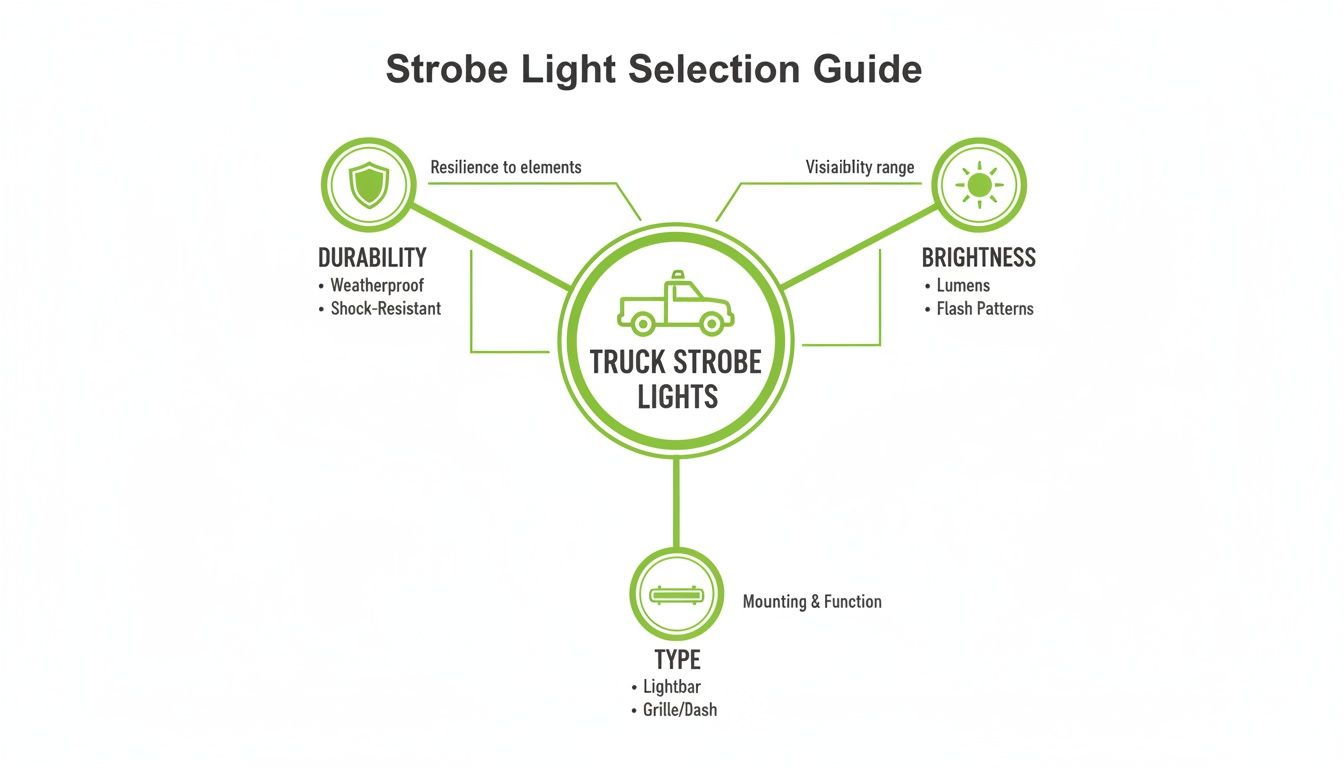
As you can see, it all starts with picking lights with the right durability and brightness for your typical work environment. Those decisions will heavily influence the best mounting locations for maximum impact.
Mapping Out the Critical Visibility Zones
To get that essential bubble of light, we have to think in four key zones. Each one is responsible for a different line of sight, and when they work together, they make sure your truck is impossible to miss—whether you’re pulling into an intersection, stopped on the shoulder, or backing up on a job site.
- Zone 1: The Roof. This is your long-range signal. Lights mounted high up on the roof or a ladder rack can be seen from far away, clearing a path over the top of other traffic. A full-size light bar is perfect for highway work, while a mini-bar gives you great visibility in town without being over the top.
- Zone 2: The Grille and Front Bumper. This is all about grabbing the attention of oncoming traffic. We install small, intense surface-mount or hideaway strobes in the grille to create an eye-level warning that drivers simply can't ignore.
- Zone 3: The Sides. This is the most commonly overlooked area, and it’s critical for preventing T-bone accidents at intersections or during lane changes. Surface-mount strobes on the fenders or running boards are a must.
- Zone 4: The Rear. Your rear-facing lights are non-negotiable. Whether you're pulled over or backing up, these lights—mounted on the bumper, tailgate, or integrated into a rack—are your primary warning for anyone approaching from behind.
You have to think about how these zones work together as a complete system. Take a landscaper's truck and trailer, for example. To be truly safe, it needs lights on the truck's cab, its rear bumper, and on the very back of the trailer. This creates one seamless warning signal that covers the entire length of the rig.
Staying Street Legal in Florida
Getting the placement right is only half the job. You also have to make sure your high-visibility setup is 100% legal. Florida has incredibly strict laws about the colors non-emergency vehicles can display, and a mistake can lead to hefty fines or even felony charges.
Florida's Lighting Color Rules:
- Amber and White: These are the go-to colors for virtually all commercial work vehicles. They signal caution and are legally approved for construction, utility, towing, and landscaping fleets.
- Red and Blue: Absolutely forbidden for civilian and commercial use. These colors are reserved exclusively for authorized emergency vehicles like police, fire, and ambulances. Using them is considered impersonating an officer—a very serious crime.
- Green: This color is restricted to designated private security vehicles and has its own set of rules.
A professional installation ensures your setup uses only legal colors and compliant flash patterns. We design every system to give you maximum safety without putting your business at risk. Having the right lights and the right placement is key, and if you need specific hardware, our experts can guide you through our catalog of top-tier mounting solutions. This makes sure you get the perfect fit for any spot on your vehicle.
What a Professional Strobe Light Installation Really Involves
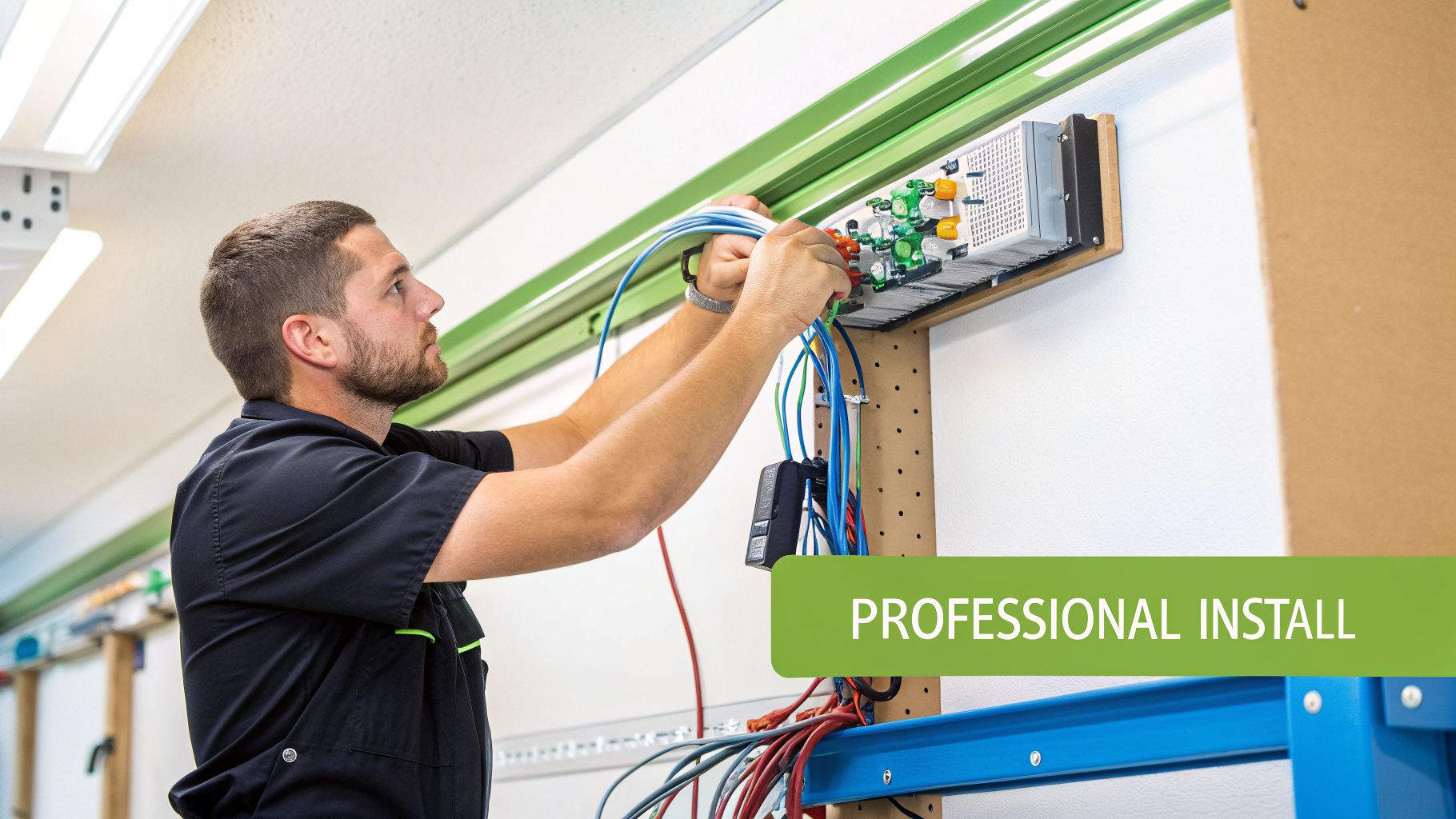
Picking out your lights and deciding where they'll go is the fun part. But the real make-or-break moment for your new warning system is the strobe light installation itself. A rushed, DIY job is a recipe for flickering lights, a dead battery when you least expect it, or even a fire hazard.
A professional installation, on the other hand, is a different beast entirely. It’s a methodical process that’s all about electrical safety and building a system that will last for years. It's part electrician, part mechanic, and all about the details. We’re pulling back the curtain to show you what goes on in our shop and why true craftsmanship is the only way to get lasting peace of mind.
This focus on getting it right is a big deal. The strobe lighting market in the United States was valued at USD 0.36 billion in 2026 and is on track to hit USD 0.54 billion by 2032. That growth is being fueled by stricter safety rules in industries that rely on strobes to keep people safe. You can dig into the numbers yourself in the full strobe lighting market report on snsinsider.com.
Building a Clean Power Foundation
The first thing we do, no exceptions, is create a safe, dedicated power source. We will never just "tap into" a nearby wire. That’s how you overload your truck’s factory circuits, which can lead to blown fuses, fried computer modules, and other expensive problems.
Instead, we run a brand new, heavy-gauge power line straight from the battery. This gives the strobe system all the juice it needs without stealing power from your truck's essential functions.
This new circuit gets its own in-line fuse right at the battery connection. Think of this fuse as a dedicated security guard for your entire vehicle. If a short ever happens in the lighting system, that fuse blows immediately, cutting power and preventing a single bit of damage to your truck.
Wiring the Brains of the Operation
With clean power ready to go, we wire up the heart of the system: the controller and flasher units. These are the little electronic brains that tell all the individual lights what to do, turning them into a single, cohesive warning signal.
A controller is what gives you command over the system, letting you:
- Switch between flash patterns for different situations—maybe a slow, alternating pattern for a highway work zone or a high-energy burst for an emergency.
- Sync all the lights to flash in perfect harmony, which dramatically increases their visibility and impact.
- Control different zones independently, like turning on only the front-facing lights or just the amber lights at the rear.
The real skill is in how it all gets wired together. Our installers carefully route and hide the wiring, tucking it into factory channels whenever possible. This isn't just about making it look clean; it's about protecting those wires from getting snagged by cargo, pinched in a door, or melted by engine heat.
The Details That Beat the Florida Climate
Down here in Fort Myers, every piece of exterior electrical work has one major enemy: humidity. Moisture is the number one killer of custom wiring, causing corrosion, random failures, and those annoying flickering lights. This is where the small details of a pro install really shine.
We seal every single connection point with weatherproof connectors and heat-shrink tubing. These materials form a watertight barrier that completely locks out moisture and salt, stopping corrosion before it can even start. A cheap crimp connector wrapped in electrical tape might last a few weeks, but it's a ticking time bomb in Florida's air.
Every wire is then meticulously secured with quality zip ties or clips. Nothing is left dangling or rubbing against a sharp metal edge that could wear through the insulation over time. This is the kind of detailed, methodical work that ensures your lights fire up every single time, year after year. It's the standard we hold ourselves to across all our expert installation services at Truck Stuff.
Integrating Strobes into a Complete Vehicle Upfit
Properly installing strobe lights isn't just about mounting a few lights and running some wires. A professional job means looking at the bigger picture. After all, your work truck is a system, and warning lights should feel like a natural part of it, not a bolted-on afterthought.
Thinking this way changes the whole process. We're not just adding lights; we're building a fully integrated, job-ready machine where every component works together. This is the core of a true vehicle upfit. It’s about getting all your gear—from lights to inverters to toolboxes—to work in harmony from a single, clean setup.
Building a Central Command Center
Think about arriving on site and hitting one switch to fire up your strobes, side-scene lights, and backup alarm all at once. That’s the kind of efficiency you get from an integrated system. Instead of a dashboard cluttered with a random assortment of switches, we can wire everything into one central switch panel.
This approach stops problems before they start. We make sure your warning lights don't create static on your two-way radio, or that your power inverter doesn’t cause your strobes to flicker. It all comes down to planning.
A truly professional upfit accounts for the entire electrical load of the vehicle. We calculate the power draw of every single accessory—from strobes to winches—to make sure the alternator and battery can handle the demand without leaving you stranded.
Real-World Examples of Integrated Upfits
The best way to grasp this is to see how it works for different trades. A properly integrated truck is purpose-built, making the operator safer and more efficient the second they pull up. Everything has its place, and every system works together seamlessly.
Here are a few common setups we build for professionals right here in Fort Myers:
- The Electrician's Van: We can tie amber warning strobes into the van's door sensors. When the side door opens, powerful LED cargo lights automatically flood the interior shelving, while exterior strobes start flashing to warn traffic. It’s a smart, hands-free setup for working safely and quickly.
- The Landscaper's F-350: On a dump truck, we can wire a rooftop light bar and rear-facing strobes directly to the dump bed controller. The moment the operator engages the hydraulics to raise the bed, the warning lights automatically activate, maximizing visibility when the crew is working around the vehicle.
- The General Contractor's Pickup: These trucks are often jack-of-all-trades. We can set up a unified switch panel to control grille lights for the front, a light bar on the ladder rack, and even integrated lighting inside the bed-mounted toolboxes. It's all powered cleanly through a single, protected electrical hub.
This is what separates a truck with a bunch of parts from a professional work vehicle. It shows a commitment to building a truck that’s not only compliant and safe but is genuinely custom-fit to how you make a living.
Our goal is simple: hand you the keys to a truck that's ready to work. By planning your strobe light installation as part of a complete upfitting package, we ensure every piece of gear works as one cohesive unit. It's the smartest way to invest in a vehicle built to perform.
Your Guide to Commercial Strobe Light Installation Costs
When you're outfitting a work truck or an entire fleet, one of the first questions is always, "What's this going to cost?" With a professional strobe light installation, there's no simple, one-price-fits-all answer. The final investment really comes down to the parts you choose, the vehicle you're working with, and how complex you need the system to be.
Think of it like this: a simple two-light setup is one thing, but a full 360-degree system with a sophisticated controller is a completely different ballgame. Both the parts and the time needed for a clean, reliable installation will scale with the job's complexity.
The Main Things That Affect Your Price
As you start to budget, you’ll see that the total cost is a mix of a few key elements. Getting a handle on these will help you understand where your money is going and what you're getting for it.
- The Lights Themselves: The hardware is a big part of the cost. A full-size LED light bar for the roof can run from a few hundred dollars to well over a thousand for a premium model. Smaller, surface-mount "puck" lights are more affordable one by one, but the cost adds up as you increase the quantity to get that crucial all-around coverage.
- Wiring & Control: The simplest installs use a basic on/off switch, which is quick and inexpensive. If you want more control—like switching between flash patterns, controlling different zones of the truck, or syncing all the lights together—you'll need a dedicated controller. That means more intricate wiring and programming, which adds to the labor cost.
- The Vehicle: Some trucks are easier to work on than others. A standard pickup usually offers pretty straightforward access for running wires. But if we're dealing with a utility body, a van with a finished interior, or any vehicle with tight spaces, it simply takes more time and finesse to do the job right.
Real-World Examples and Cost Estimates
So, what does this look like in practice? Here are a couple of common scenarios to give you a ballpark idea. Remember, these are just estimates—the best way to know for sure is to get a custom quote for your specific truck and needs.
For a solid, entry-level professional setup on a single work truck, you might have two grille lights up front and two strobes on the rear, all run to a simple switch. For a job like this, you can typically budget between $400 and $800. That gets you quality, durable parts and the expert labor to make it last.
If you need a more advanced package for a commercial van or a heavy-duty truck working in busy environments, the investment will be higher. A system with a rooftop mini-light bar, strobes on the sides, and a multi-pattern controller could land anywhere from $1,200 to $2,500+. This ensures you have maximum visibility and total control, which is essential for keeping your crew safe on the job.
While it’s easy to focus on the upfront number, a professional strobe light installation is an investment in safety and reliability. By using high-quality components and trusting the work to experienced technicians, you’re buying peace of mind, DOT compliance, and a system that won’t fail when you need it most.
Your Strobe Light Installation Questions, Answered
Getting a professional strobe light installation is a smart move, but it's natural to have a few questions before you commit. We hear a lot of the same ones from fleet managers and tradespeople here in Fort Myers, so let's clear them up.
What Color Strobe Lights Are Legal for My Truck in Florida?
This is probably the most critical question we get, and for good reason. For virtually all commercial work trucks, the only legal colors for warning lights are amber and white.
Florida's laws are incredibly strict on this. Red and blue lights are reserved exclusively for first responders like police and fire departments. Using the wrong colors isn't a small mistake—it can lead to hefty fines and serious legal headaches. We're experts in state compliance and make sure every light we install is 100% legal for your vehicle's use case.
Will Installing Strobe Lights Drain My Truck's Battery?
Not when we're the ones doing the installation. Modern LED strobes are incredibly efficient and sip power, but the real key is in the wiring.
We never just tap into a random power source. We wire your lights to a dedicated, switched circuit. This means they only draw power when your truck's ignition is on and you've actually flipped the switch to activate them. No phantom drain, no dead batteries in the morning.
Think of it like this: A proper installation gives your lights their own safe, managed power line. By using a separate, fused circuit, we ensure the lights can't interfere with your truck's factory wiring or sensitive onboard computers. It protects your entire electrical system.
How Long Does a Professional Installation Take?
The timeline really depends on the scope of the job. A straightforward setup, maybe a couple of lights on a standard pickup, might only take a few hours.
On the other hand, a complex system with a rooftop light bar, grille lights, and a custom switch panel on a heavy-duty truck could easily be a full day's work. We always provide a clear time estimate with our quote so you can plan for the vehicle's downtime.
Can You Install Lights I Bought Somewhere Else?
In many cases, yes, we can install parts you provide. However, our first step is always to inspect the equipment to make sure it meets our quality and safety standards. We've seen a lot of low-quality gear fail prematurely.
For guaranteed performance and a solid warranty that covers both the parts and our labor, we always recommend using the professional-grade brands we stock. We stand behind them because we've seen them hold up in the real world.
Ready to equip your fleet with the right safety lighting? The team at Truck Stuff has the experience to design and install a durable, compliant system built for the work you do. Stop by our shop in Fort Myers or check out your options online at https://truckstuff.com.