
When it comes to picking tires for your truck, the choice really boils down to one core question: specialization or versatility? Mud-terrain (MT) tires are the specialists—they’re built with one job in mind: conquering the most aggressive off-road terrain with massive tread blocks and deep voids. On the flip side, all-terrain (AT) tires are the jack-of-all-trades, designed to give you a solid, balanced performance whether you're on the highway or a light trail.
Choosing Your Next Truck Tires in Fort Myers
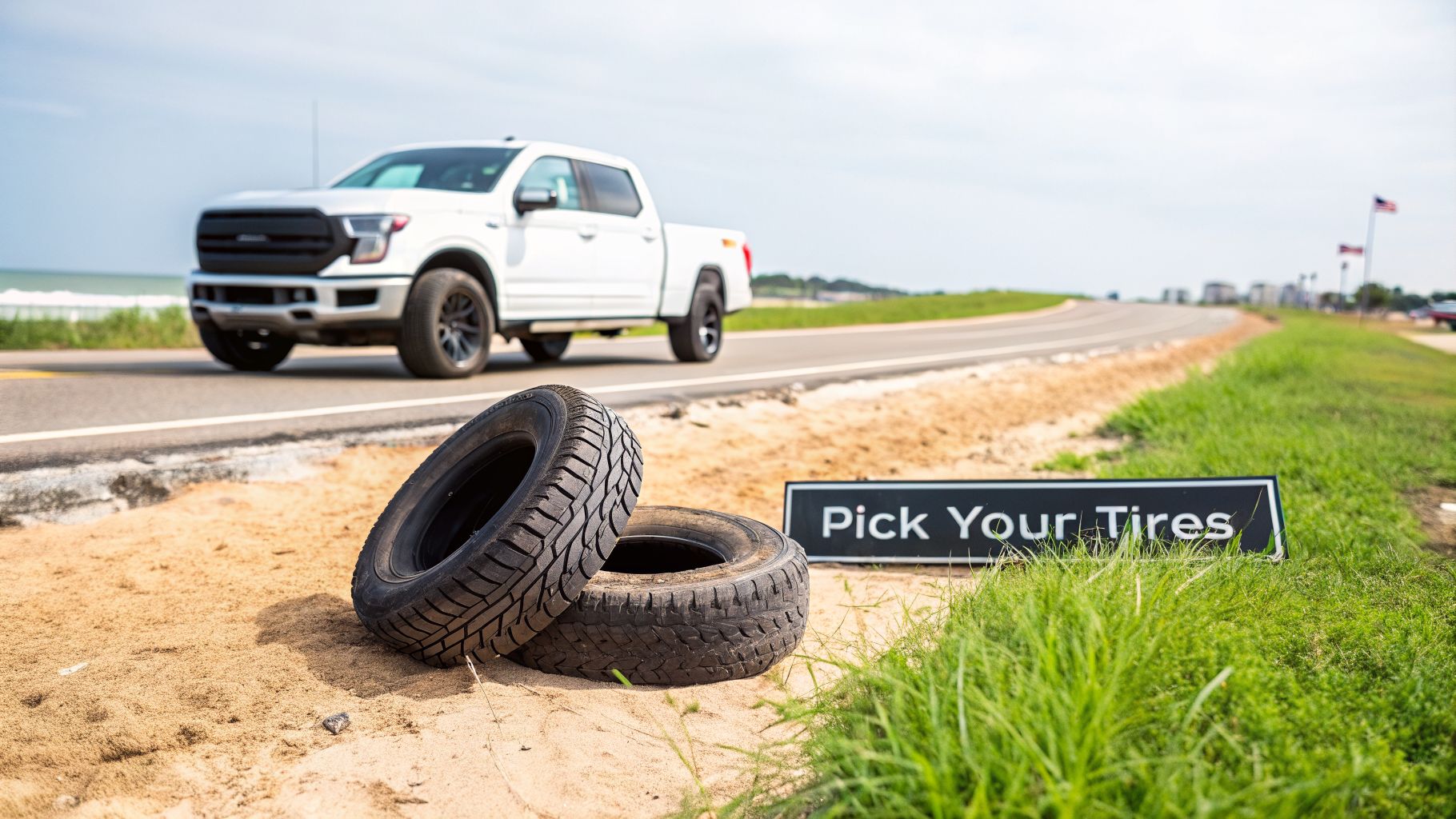
For truck owners here in Fort Myers, this isn't just a cosmetic decision. The right set of tires makes all the difference, whether you're just commuting down I-75 or trying to get through a muddy job site after one of our famous afternoon downpours. It's a choice that directly impacts your truck's performance, your safety, and your wallet.
And it’s a choice more and more drivers are making. The demand for serious off-road rubber is surging, with the global mud tire market hitting $8.3 billion in 2024 and expected to climb to $14.2 billion by 2033. At the same time, all-terrains have become the go-to for daily drivers, now making up 45% of all off-road tire sales thanks to their do-it-all nature.
Ultimately, the best tire for you comes down to being honest about how you actually use your truck. A knobby MT tire is total overkill for a truck that spends 95% of its life on pavement, but an AT tire will leave you spinning your wheels in deep, sloppy mud.
This guide will walk you through a practical, side-by-side comparison. We'll break down exactly how each tire type handles the unique conditions we see here in Southwest Florida, so you can make a smart investment that has your truck ready for anything.
Mud-Terrain vs. All-Terrain Quick Comparison
Before we get into the weeds, here’s a quick look at the major differences. This table lays out the trade-offs you’ll be making.
| Feature | Mud-Terrain (MT) Tires | All-Terrain (AT) Tires |
|---|---|---|
| Primary Use | Extreme Off-Road (Mud, Rocks) | Daily Driving & Light Off-Road |
| On-Road Noise | Loud | Moderate |
| Tread Life | Shorter (25k-40k miles) | Longer (50k-70k miles) |
| Off-Road Grip | Maximum | Good |
Getting a handle on these core differences is the first step. If you're looking to pair your new rubber with the right rims, our complete guide on aftermarket wheels and tires is a great place to see how it all comes together.
Understanding Core Differences in Tire Construction
To really get to the heart of the mud-terrain vs. all-terrain debate, you have to look at how they're built. It’s not just about aggressive looks; the way a tire is engineered from the inside out determines its personality on and off the pavement. Everything from its tread design to the rubber it’s made of dictates how it will handle, how loud it will be, and how long it will last.
Let's break down what makes these two tires so different, starting with the specialist of the duo.
The Anatomy of a Mud-Terrain Tire
Mud-terrain (MT) tires are built with a single-minded purpose: conquering the most challenging off-road conditions you can find. Their construction is all about brute force and traction.
You can spot an MT tire from a mile away thanks to its massive, widely spaced tread blocks. This is called a high-void tread pattern, and it’s designed to act like a set of paddles, churning through soft stuff like deep mud, loose dirt, and sand. Those big gaps between the lugs are essential for self-cleaning—they fling mud and debris out as the tire spins, so you always have a fresh biting edge ready for the next rotation.
They also feature incredibly tough sidewalls, often built with three or more layers (plies) of thick, durable material. This is your defense against punctures from sharp rocks, roots, and other trail hazards. The rubber compound is also much softer, which helps the tire flex and wrap around obstacles for maximum grip. The trade-off, of course, is that they wear down much faster on the highway.
Key Takeaway: The aggressive, high-void tread and multi-ply sidewalls of an MT tire prioritize extreme off-road grip and puncture resistance above all else. This construction is what makes them dominant in mud but loud and fast-wearing on the highway.
The Engineering of an All-Terrain Tire
All-terrain (AT) tires, on the other hand, are the masters of compromise. Think of them as the Swiss Army knife of the tire world. Their construction is a careful balancing act, designed to give you dependable performance whether you're cruising down I-75 or exploring a sandy trail out near Pine Island.
AT tires have a much tighter tread pattern with smaller, interlocking blocks. This puts more rubber in contact with the pavement, which translates directly to better handling, more stability at highway speeds, and a significantly quieter ride. You won’t get that classic MT hum.
A key feature you'll notice is siping—tiny slits cut all over the tread blocks. These little grooves create thousands of extra biting edges that are fantastic for gripping wet pavement, which is a huge plus for dealing with Florida's unpredictable afternoon downpours. The rubber compounds are also harder and more durable than an MT's, which is why they can last so much longer—often 50,000 to 70,000 miles. This balanced approach gives you solid off-road chops without giving up the on-road manners you need for a daily driver.
Performance Showdown On and Off the Road
The real debate between mud-terrain and all-terrain tires boils down to how they perform where it counts—on the road and off it. For truck owners in Fort Myers, that could mean a slick highway commute, a sandy job site, and a muddy trail all in the same week. This is where we break down how each tire handles the environments you actually drive in.
Let’s start with the most common scenario for any truck: daily driving on pavement.
Highway and Pavement Performance
Get on a smooth stretch of I-75, and the difference between these two tires becomes crystal clear, mostly through your ears. All-terrain tires, with their tighter tread blocks and extensive siping, are built for a quiet, stable ride. They feel much more like a standard passenger tire, giving you predictable steering and confident braking whether the pavement is dry or wet.
Mud-terrain tires are a whole different beast on the highway. Those massive, widely spaced lugs create a ton of road noise—a distinct hum that can get old on a long drive. It’s not uncommon for MT tires to generate 10-15 dB more road noise than their AT cousins. That aggressive tread also means less rubber is actually touching the road, which can increase your braking distance and make handling feel a bit sluggish, especially in a sudden Florida downpour where hydroplaning is a real risk.
Key Differentiator: For on-road comfort and safety, an all-terrain tire is the hands-down winner. Its design is all about a quiet ride and solid handling on pavement, making it the practical choice for any truck that doubles as a daily driver.
This infographic breaks down the core design differences that dictate how these tires behave.
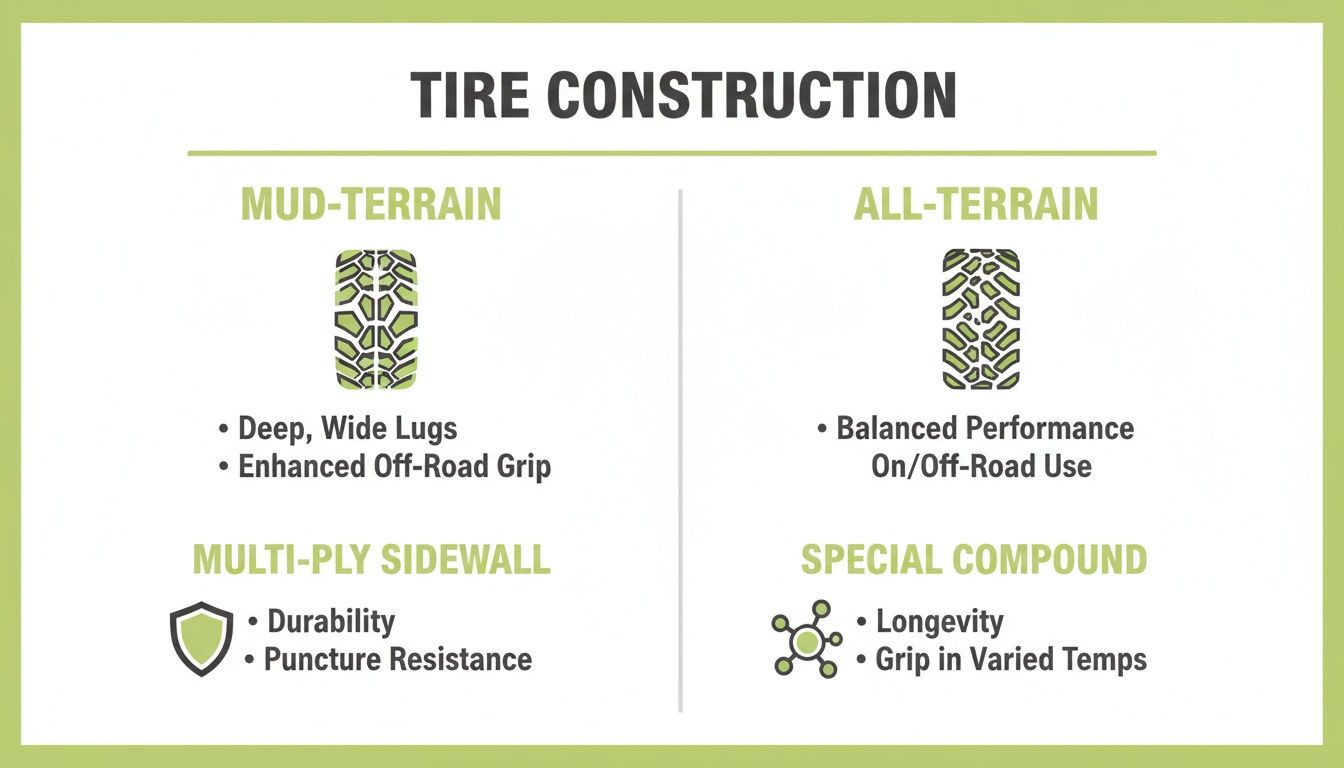
You can see how the MT tire's aggressive, open tread and beefy sidewall are purpose-built for extreme terrain. In contrast, the AT tire’s interlocking pattern and specialized compound are engineered for more balanced, all-around performance.
Performance in Deep Mud
The moment you leave the pavement for the deep, sticky mud you find after a heavy rain or on a rural job site, the tables turn completely. This is where a mud-terrain tire absolutely shines. Its high-void tread pattern acts like a set of paddles, digging deep and aggressively flinging mud away with every rotation. This self-cleaning ability is non-negotiable for maintaining traction.
In head-to-head tests, MT tires have shown a 35% superior mud evacuation rate, clearing out muck in under two seconds per rotation. This makes them a must-have for contractors and serious off-roaders who can't afford to get stuck. An all-terrain tire, with its tighter tread, will quickly get packed with mud, essentially turning into a slick and losing all its grip.
Traction on Sand and Snow
Navigating the soft sand on the way to the beach or a coastal construction site presents a different kind of challenge, and the most aggressive tire isn't always the best choice here.
- Mud-Terrain Tires: The huge lugs on an MT tire have a bad habit of digging down into soft sand. Instead of moving you forward, they act like shovels, quickly burying your truck.
- All-Terrain Tires: An AT tire, especially when you air it down a bit, creates a wider, more even footprint. This allows the tire to "float" on top of the sand instead of digging in, giving you much better momentum.
The story is similar when it comes to snow. The thousands of small cuts, or sipes, on an all-terrain tire give it extra biting edges to grip packed snow and ice. In fact, many AT tires now carry the Three-Peak Mountain Snowflake (3PMSF) rating, which certifies them for severe snow conditions. MT tires, with their large, smooth lug surfaces, really struggle to find a grip on anything slick or icy.
If you want to see all the different styles and brands available, you can browse our complete collection of wheels and tires.
Analyzing the True Cost of Ownership
The sticker price is just the beginning. When you're weighing mud terrain vs. all terrain tires, the real story unfolds over the life of the tire. The true cost of ownership is where your budget can take a serious hit, and while that aggressive MT tire looks incredible, its long-term financial impact on a daily driver or commercial fleet here in Lee County can add up faster than you'd think.
The biggest difference you'll feel in your wallet comes down to tread life. Mud-terrain tires use softer rubber compounds to claw their way over rocks and through muck, but that same soft rubber gets chewed up by abrasive pavement. This is especially true on Florida's hot asphalt, which acts like sandpaper, accelerating wear dramatically.
All-terrain tires, on the other hand, are built for the long haul. Their firmer rubber compounds and less aggressive tread patterns are engineered for highway miles, giving them a massive advantage in durability for anyone who spends most of their time on pavement.
Tread Life and Replacement Costs
You can expect a typical set of mud-terrain tires to last somewhere between 25,000 to 40,000 miles. If you're doing mostly highway driving, you might see even less than that. In stark contrast, a quality all-terrain tire often pushes 50,000 to 70,000 miles, sometimes more.
What does that mean in practical terms? You could easily find yourself buying a second set of MTs before a good set of ATs has even worn halfway down. This effectively doubles your tire budget over the same timeframe.
The numbers don't lie. Data from a mud tire market analysis shows that MTs can wear out two to three times faster on pavement, sometimes lasting only 20,000-30,000 miles against an AT's 50,000+ mile potential. This is made worse by their higher initial price—MTs often run $200 to $500 per tire, whereas similar ATs are in the $120 to $450 range.
The Financial Bottom Line: For a truck owner in Fort Myers, choosing MT tires for your daily commute could mean replacing them every couple of years. A set of ATs could last you four or five years. That extended life is a huge factor in keeping your total costs down.
The Hidden Cost of Fuel Economy
Another major expense is lurking at the gas pump. The heavy, aggressive tread on a mud-terrain tire creates a ton of rolling resistance. Your engine has to work harder just to keep the truck moving, and that directly impacts your fuel economy.
You're often looking at a penalty of 1 to 2 miles per gallon (MPG) compared to an all-terrain tire. That might not sound like a deal-breaker, but it adds up significantly over thousands of miles.
Cost Scenario: Fuel Economy Impact
Let's break it down for a Ford F-150 that drives 15,000 miles a year around the Fort Myers area:
- With AT Tires (18 MPG): You'll use about 833 gallons of fuel per year.
- With MT Tires (16 MPG): That number jumps to 938 gallons of fuel per year.
- The Difference: You're buying an extra 105 gallons of gas every single year.
With gas hovering around $3.50 per gallon, that's an extra $367.50 out of your pocket annually just for choosing MTs. If you're running a commercial fleet, multiply that across every truck, and your tire choice suddenly becomes a major operational expense.
Of course, proper tire and wheel care will help you get the most out of any tire, but it can’t change the fundamental differences in wear and efficiency.
Which Tire Is Right for Your Fort Myers Lifestyle?
Alright, we’ve crunched the numbers and laid out all the technical specs. But the real question in the mud-terrain vs. all-terrain debate isn't about data—it’s about you. Your truck is a tool, a toy, and a reflection of how you live, so the right tire comes down to how you spend your time in and around Fort Myers.
To make it simple, let's break it down into a few common truck owner profiles we see all the time. Find the one that sounds most like you, and you’ll have your answer.
The Weekend Warrior
You’re the person who checks the weekend forecast hoping for rain. Your truck is your ticket to the trails at Redneck Mud Park or for exploring the soggy backroads of the Picayune Strand State Forest. For you, pavement is just the boring part of the journey between your driveway and the trailhead.
- Your Driving Breakdown: Roughly 70% off-road and 30% on-road. You'll happily trade a few MPGs and a quiet ride for the guarantee you won't be the one getting stuck.
- Your Top Priority: Unstoppable grip. You need a tire that digs through deep mud, chews through ruts, and crawls over anything in its path without a second thought.
- The Verdict: Mud-Terrain (MT) Tires. This is an easy call. For you, there’s no substitute for the extreme performance of an MT. Those massive, self-cleaning tread blocks and armor-plated sidewalls are built to conquer the gnarliest terrain Southwest Florida can throw at you. The on-road compromises are just part of the game for total off-road confidence.
The Commercial Contractor
Your work truck is your business partner. It has to be ready for anything, from hauling equipment down I-75 to navigating a soupy, post-downpour construction site in Lehigh Acres or Cape Coral. You can’t afford downtime, so reliability and versatility are everything.
- Your Driving Breakdown: A mix of 60% on-road and 40% off-road, but that "off-road" can be anything from gravel and dirt to light mud.
- Your Top Priority: A jack-of-all-trades tire. You need something that can handle a messy job site but won't get chewed up by highway miles or destroy your fuel budget.
- The Verdict: All-Terrain (AT) Tires. An AT is the workhorse you're looking for. It gives you great on-road manners, a much longer tread life, and better fuel economy for all those miles you rack up. At the same time, it has more than enough bite to get you through the muck and mess of a typical Florida job site. It’s the perfect blend of capability and cost-effectiveness.
Think of it this way: a newer hybrid or rugged-terrain (RT) tire could also be a fantastic choice here. They split the difference, giving you a bit more off-road aggression than a standard AT without the full-on noise and wear of a true MT.
The Daily Driver with an Aggressive Look
Let’s be honest—you love the tough, capable look a beefy tire gives your truck. It’s your daily ride for commuting and running errands around Fort Myers, but you want the confidence to handle the occasional dirt road, a slippery boat ramp, or a sudden tropical downpour without white-knuckling it.
- Your Driving Breakdown: Almost entirely on-road, maybe 95% pavement with just 5% dedicated to light off-roading or bad weather.
- Your Top Priority: Getting that aggressive stance without sacrificing daily livability. Comfort, low noise, and good tread life are just as important as looks.
- The Verdict: All-Terrain (AT) Tires. This is a clear win for ATs. You get that powerful aesthetic you want without having to live with the constant hum, poor wet-pavement grip, and rapid wear of a dedicated mud tire. A modern all-terrain gives you a quiet, comfortable ride and, most importantly, is far safer and more predictable during our heavy summer rainstorms.
Ensuring Expert Installation and Fitment
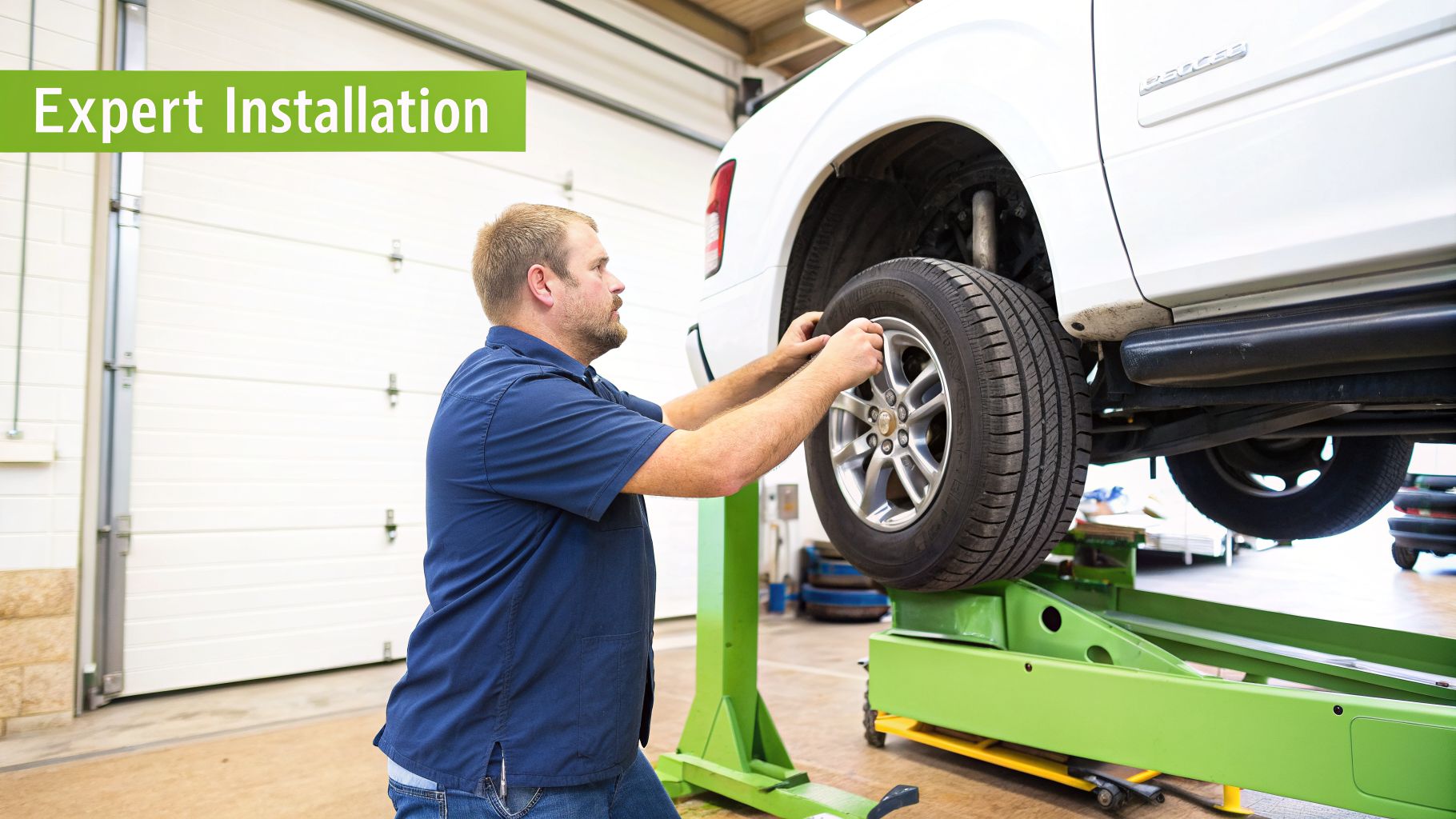
Picking the right tire is just the first step. Getting them mounted and balanced correctly is what really makes the difference, and it’s a job you don’t want to leave to chance. This is especially true when you’re moving up to a set of big, heavy MT tires. A DIY job in the driveway can quickly turn into a headache with vibrations, alignment issues, or fender rub.
Here in our Fort Myers shop, we see this stuff every day. When we’re throwing a set of aggressive mud-terrains on a Chevy Silverado or Ford F-150, we’re not just slapping them on—we’re checking every single clearance point and using high-end balancers to kill any potential for highway shimmy. It’s also clear who needs what around here; Lee County work trucks are almost always on MTs, while ATs are king for the daily driver crowd looking for stability. A professional fitment avoids problems like the uneven wear we see in an estimated 15% of DIY swaps. For more on this, check out these market insights and tire data.
A perfectly installed tire is a safe tire. Professional fitment isn't an upsell—it's the necessary final step to protect your investment and ensure your truck performs exactly as it should, whether on the highway or a trail.
We offer a complete, hands-off solution that takes you from picking the right tire to driving away with a perfect fit. Learn more about our professional tire installation services and let our experts handle it right the first time.
Answering Your Top Questions
When you're trying to decide between mud-terrain and all-terrain tires, a few questions always seem to pop up. We hear them all the time from truck owners here in Fort Myers. Let’s get you some straight answers based on our hands-on experience.
Are Mud-Terrain Tires a Good Idea for Daily Driving in Florida?
Honestly, for most people, they’re not the best choice for a daily driver. While you can use them on the street, you'll be making some serious trade-offs.
MT tires are loud on pavement, and they wear down much faster on our hot asphalt roads. You’d be lucky to get 25,000-40,000 miles out of a set. If your daily commute involves stretches of I-75, an all-terrain tire is going to give you a far better experience with more comfort, longer life, and better value.
Do I Have to Get a Lift Kit to Fit Mud-Terrain Tires?
More often than not, yes. MT tires are built bigger and more aggressively than what comes from the factory. To keep them from rubbing on your fenders, frame, or suspension parts when you turn or go over bumps, a lift or leveling kit is usually required to create the necessary clearance.
Our technicians can take a look at your truck and figure out the perfect setup to make it work right.
Key Insight: While an all-terrain tire can often fit on a stock truck without any issues, stepping up to a true mud-terrain tire almost always means you need to think about suspension mods. It's the only way to avoid damaging your truck or your brand-new tires.
How Do All-Terrain Tires Handle Our Heavy Florida Rains?
Modern all-terrain tires are fantastic in the rain. Their tread designs have deep grooves and tons of siping—those little slits in the tread blocks—that are specifically engineered to pump water out from under the tire. This is absolutely critical for preventing hydroplaning in a sudden downpour.
The advanced rubber compounds they use these days also give you much better grip on wet roads, making them a way safer bet than an MT tire when the skies open up.
For Sand, Is an All-Terrain or Mud-Terrain Tire Better?
This one is a little tricky, and the answer might surprise you. A mud-terrain tire's massive lugs are designed to dig, which is the last thing you want in soft sand—it'll just dig you in deeper until you're stuck.
An all-terrain tire, especially when you air it down a bit, creates a wider footprint that helps it "float" over the top of the sand. For the kind of beach driving we do around here, an AT tire is almost always the more reliable and effective choice.
Ready to transform your truck with the perfect set of tires? The experts at Truck Stuff are here to help you choose, install, and get the most out of your investment. Visit our Fort Myers shop or explore our full range of truck accessories online at https://truckstuff.com.